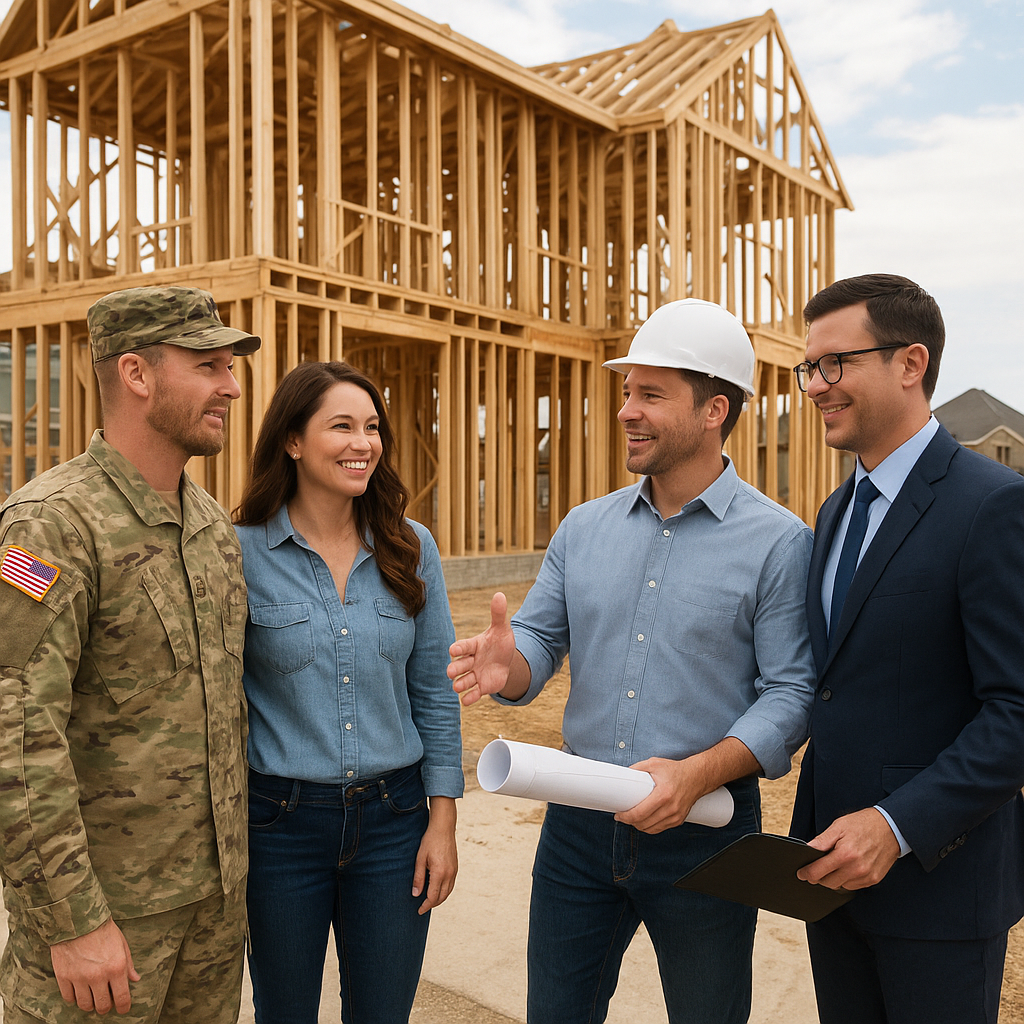
I'm Bond Peter Njoku, a Mortgage Loan Officer (NMLS #2670329) based in Garland, and I work with veterans throughout DFW and surrounding Texas counties. Most veterans know that a VA loan means zero down on a home purchase — but fewer realize they can apply that same benefit to building a completely custom home from the ground up. A VA construction loan lets eligible veterans finance land acquisition and home construction in a single package, with no down payment required for qualifying borrowers with full entitlement.
If you've ever wanted to design your own floor plan, choose your lot, and avoid inheriting someone else's deferred maintenance — a VA construction loan may be the path to get there. Here's how it works in Texas in 2026, including an important rule change that went into effect earlier this year.
What is a VA construction loan and how is it different from a regular VA purchase loan?
A regular VA purchase loan is used to buy an existing home — one that's already built, inspected, and ready to occupy. A VA construction loan is used to finance the building of a home that doesn't exist yet. It covers the cost of the land (if you're purchasing it as part of the project) plus the construction draws as the builder completes each phase. Once the home is complete and passes the final VA appraisal, the construction loan converts to a permanent VA mortgage.
The key difference in 2026: as of March 31, 2026 (VA Circular 26-25-01), the VA eliminated its Builder Identification Number requirement. Previously, a builder had to formally register with the VA before any new construction project could move forward under VA financing. That process took weeks and discouraged many local and custom builders from accepting VA clients. Now, the lender is responsible for vetting the builder — checking their contractor's license, liability insurance, and project history. This opens VA construction loans to a broader range of Texas builders than ever before.
One-time close vs two-time close: which VA construction loan structure is right for you?
| Feature | One-Time Close (OTC) | Two-Time Close (TTC) |
|---|---|---|
| Number of closings | 1 — at start of construction | 2 — construction + permanent |
| Rate lock | Locked at initial closing | Float during construction, lock at permanent closing |
| Closing costs | Paid once | Paid twice (construction + permanent) |
| VA funding fee | Paid once at initial close | Paid once at permanent loan close |
| Flexibility | Less — you're committed to both phases upfront | More — can shop permanent lenders at completion |
| Rate risk | Protected if rates rise during construction | Exposed to rate increases during construction |
| Best for | Most veterans — simpler, lower total cost | Veterans expecting rates to drop by completion |
| Typical timeline | 45-60 days to first draw; 8-18 months build | 30-45 days construction close; 30-45 days perm close |
For most DFW veterans in 2026, the one-time close (OTC) is the simpler and usually cheaper option. You pay one set of closing costs, lock your rate at the start, and never have to refinance or requalify at construction completion. The downside is that you're exposed to rate risk in reverse — if rates drop significantly during your build, you don't capture that improvement. Given the current rate environment (VA rates 6.25–6.5% in 2026), most veterans are comfortable locking now.
What are the builder requirements for a VA construction loan in Texas in 2026?
Since the VA eliminated its official Builder ID requirement (effective March 31, 2026), the lender is now responsible for builder vetting. Here's what I look for when approving a builder for a VA construction loan in Texas:
- Active contractor's license: The builder must hold a current Texas residential contractor's license for the county and type of construction.
- General liability and workers' compensation insurance: Coverage must be in place before the first draw is requested.
- Project history: Most lenders require 24+ months of comparable Texas construction project history — meaning similar-size homes in comparable conditions.
- Fixed-price contract: The VA construction loan requires a fixed-price (not cost-plus) contract so the appraiser can determine the Notice of Value before construction begins.
- Completion guarantee: The builder must provide adequate documentation that the project can and will be completed per the plans and specs.
How much does a VA construction loan cost on a $450,000 build in DFW?
Let me show you the real math. Say you're building a 2,800 sq ft custom home in Forney, TX: land cost $90,000, construction cost $360,000, total project $450,000.
VA One-Time Close Construction Loan (full entitlement, 0% down):
Total project cost: $450,000
VA funding fee (2.15%, first use): $9,675
Total loan amount: $459,675
Interest-only during construction (12 months at 6.5%): ~$2,490/mo
Permanent payment (6.5%, 30yr): $2,908/mo P&I
Estimated taxes (Kaufman County ~1.9%): $713/mo
Insurance: $150/mo
Total PITI after conversion: ~$3,771/mo
Monthly PMI: $0
Conventional construction loan (10% down, 7.0% rate):
Down payment: $45,000
Loan amount: $405,000
Permanent payment (7.0%, 30yr): $2,695/mo P&I
PMI (~0.7%): $236/mo
Taxes + insurance: $863/mo
Total PITI: ~$3,794/mo
Down payment required: $45,000
The VA construction loan achieves nearly the same monthly payment as conventional — with zero down payment and no PMI. If your disability rating is 10% or higher, the $9,675 VA funding fee is waived, making the VA loan definitively cheaper month-to-month as well.
How does the Texas Veterans Land Board (VLB) work with a VA construction loan?
Texas has a Veterans Land Board program specifically for purchasing rural land — veterans can finance up to 100 acres at 5% down with competitive fixed rates through the VLB. This is a state-funded program separate from the federal VA benefit. The two programs don't stack on the same transaction, but they can be used in sequence: a veteran can use the VLB land loan to purchase their lot first, then apply for a federal VA construction loan to build the home on that land. Veterans rated at 30% or higher service-connected disability qualify for discounted VLB rates. If you're considering a rural build in Kaufman, Henderson, or Hunt County, this combination is worth exploring. Text me at 469-545-7180 and I'll walk you through how both programs could work for your specific situation.
What do I need to get started on a VA construction loan in Texas?
Early last year, I helped a veteran relocating from Killeen to the DFW area — 15 years of service, honorably discharged, 730 credit score, income of $112,000 from federal civilian employment. He wanted a custom home with an attached workshop on 2 acres in Forney. We used a VA one-time close construction loan: land ($85,000) plus construction ($365,000), total $450,000. The builder was a small local custom builder who had never worked with VA before — but he had 10 years of Texas construction history and all the required licensing. With the builder ID requirement gone, we were able to start the process without any VA builder registration delay. The veteran paid zero down, and his monthly PITI came in at $3,820 — including property taxes and insurance. He moved in 11 months after we closed the initial construction loan.
To get started on a VA construction loan, you'll need: your Certificate of Eligibility (COE), W-2s or tax returns for the past two years, pay stubs, bank statements, the builder's license and insurance certificates, a set of completed architectural plans and specs, and a fixed-price contract from the builder. Call or text me at 469-545-7180 and I'll help you assemble the file from the very beginning.
Frequently Asked Questions
Can I build a custom home in Texas using my VA benefit?
I'm Bond Peter Njoku (NMLS #2670329) and yes — eligible veterans can use a VA construction loan to finance land and a home build with zero down payment. The loan bundles land and construction financing into one package, and once complete, it converts to a permanent VA mortgage. As of March 2026, builders no longer need a VA-issued Builder ID — I vet the builder directly. Call or text me at 469-545-7180 to discuss your custom build plans.
What's the difference between a one-time close and two-time close VA construction loan?
I'm Bond Peter Njoku (NMLS #2670329) and the one-time close (OTC) combines land purchase, construction, and permanent financing into a single closing — one set of closing costs, one rate lock. The two-time close (TTC) requires two separate closings but gives you more flexibility to shop rates when the home is complete. For most DFW veterans building in 2026, the one-time close is simpler and usually cheaper. Call or text me at 469-545-7180 to compare both for your project.
How long does a VA construction loan take from start to move-in?
I'm Bond Peter Njoku (NMLS #2670329) and the total timeline typically runs 12-18 months for a fully custom home and 8-10 months for a semi-custom build in a planned DFW community. The loan application through first draw takes 45-60 days. Once construction is complete and the final VA inspection passes, the loan converts to a permanent VA mortgage with no second closing on a one-time close loan. Call or text me at 469-545-7180 to map out a timeline for your project.
Do I need to own land before applying for a VA construction loan?
I'm Bond Peter Njoku (NMLS #2670329) and no — you can finance land acquisition as part of the VA construction loan. If you already own the land free and clear, that equity can count toward the loan calculation. Texas also has the Veterans Land Board (VLB) land loan program for veterans purchasing rural land (up to 100 acres at 5% down) — the VLB land loan and a federal VA construction loan can work in sequence. Call or text me at 469-545-7180 to talk through your land situation.
Ready to build your custom home in Texas using your VA benefit?
I'm Bond Peter Njoku (NMLS #2670329). I help DFW veterans navigate VA construction loans from the builder vetting process through the final draw and permanent conversion. Call or text me at 469-545-7180, message me on WhatsApp, or start your VA pre-approval online.