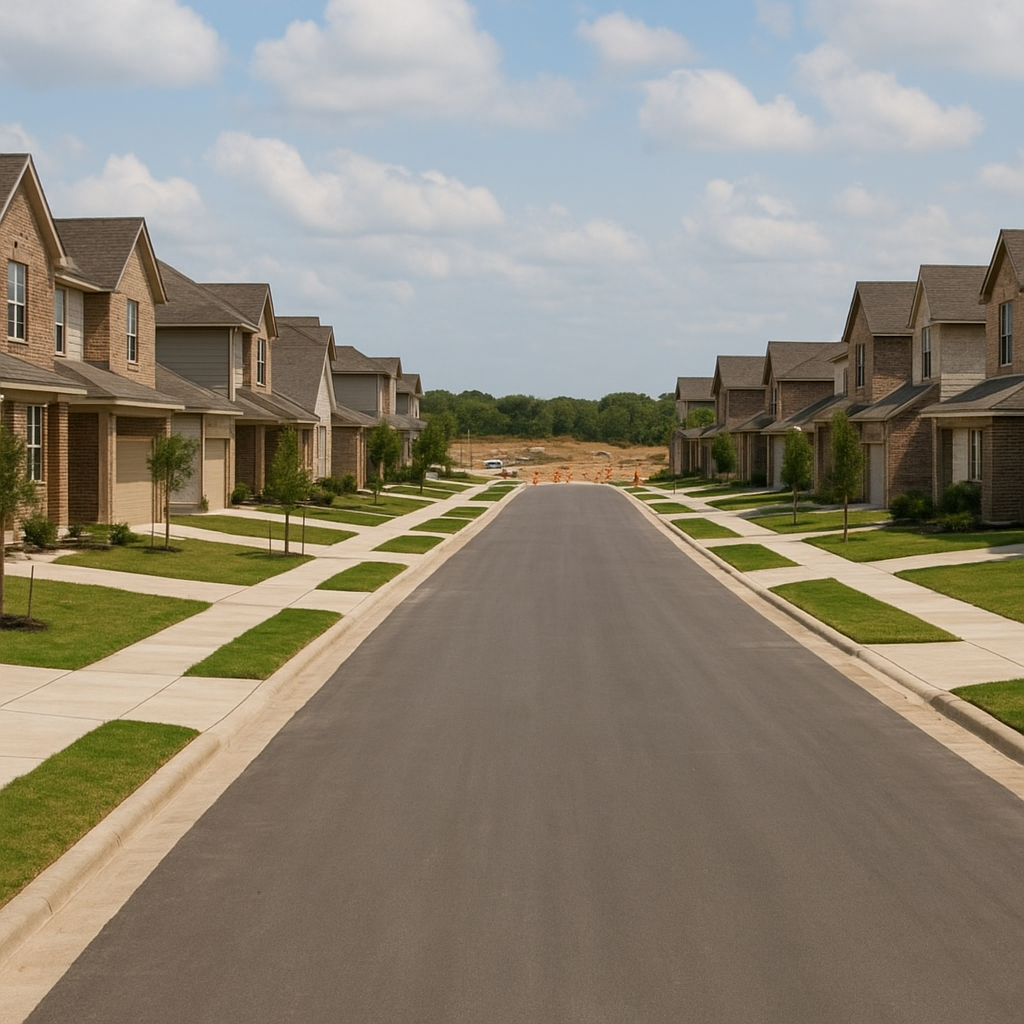
I'm Bond Peter Njoku (NMLS #2670329), and I've had more than one buyer in Forney or Prosper find out too late that the home they fell in love with carries a MUD tax that adds $250-$350 to their monthly payment on top of everything else. A Municipal Utility District, or MUD, is a special taxing district that funds the water, sewer, and drainage infrastructure a new subdivision needs — and DFW's fastest-growing suburbs, especially in Kaufman and Collin County growth corridors, use them constantly. If nobody explains the math before you go under contract, it can quietly change what you can actually afford.
What exactly is a MUD, and why does it exist?
A MUD is a political subdivision of the state of Texas, created under Texas Water Code Chapter 49/54, with the authority to issue bonds. A developer builds the underlying infrastructure — water lines, sewer, storm drainage, sometimes roads and parks — and the MUD issues bonds to reimburse that cost. Every homeowner inside the district's boundary then pays a MUD tax, calculated as a rate per $100 of assessed home value, until those bonds are retired. It's a separate line item from your city, county, and school district property taxes, and it shows up on the same consolidated tax bill and the same title company tax certificate.
How much does a MUD tax actually add to my mortgage payment?
The rate varies district by district, but the swing is bigger than most buyers expect. Here's the math on a $450,000 home at two different rates I've seen in real DFW districts:
| MUD rate (per $100 value) | Monthly cost on a $450K home | Annual cost |
|---|---|---|
| $0.25 | ~$94/mo | ~$1,125/yr |
| $0.50 | ~$188/mo | ~$2,250/yr |
| $0.85 (higher-rate district) | ~$319/mo | ~$3,825/yr |
That's a $225-per-month swing between the low and high end on an identical house — money that goes straight into your escrow account alongside your regular property tax, on top of principal, interest, and homeowners insurance. Across DFW, MUD taxes typically add somewhere between $200 and $400+ a month depending on the district's bond load and how early in its repayment schedule it is.
Which DFW areas commonly carry MUD or PID taxes?
MUDs are much more common in fast-growing new-construction corridors than in established neighborhoods. In the areas I work most — Forney, Royse City, and Prosper — newer master-planned communities built out with district-funded infrastructure frequently carry a MUD or a related PID (Public Improvement District, which functions similarly but is city-created rather than a separate political subdivision). Older, already-built-out sections of those same cities usually don't. It's not a reason to avoid Forney, Royse City, or Prosper — it's a reason to check the specific address before you get attached to a house, the same way you'd check flood zone or school district.
How does a MUD tax affect what I can qualify for?
Because MUD tax flows through your escrow account exactly like property tax, it counts toward your front-end housing ratio and your total debt-to-income ratio when I underwrite your file. A high MUD rate on an otherwise-affordable home can reduce your approved loan amount by roughly $30,000 to $70,000 compared to an identical home with no MUD tax — because that extra $200-$400 a month has to come out of the same qualifying budget as your principal and interest. I've seen buyers get pre-approved for one number, then have that number shrink once we ran the actual numbers on a MUD-heavy address.
What happens once the MUD bonds are paid off?
MUD bonds are structured to retire over 20 to 30 years. Once they're paid off, the district's tax rate typically drops sharply, and in some cases the MUD is dissolved entirely and its functions are absorbed by the city. The catch: some districts issue additional bonds as a development continues to build out new phases, which can extend the higher-rate period longer than a buyer might assume from looking at the current rate alone. This is exactly the kind of detail a title company's tax certificate or the district's own bond disclosure will spell out, and it's worth asking for before you close.
Named example: a Forney buyer whose MUD tax changed the plan
Last year I worked with a couple buying a new-construction home in a Forney MUD district, purchase price $335,000, targeting FHA financing. Their initial pre-approval assumed a standard Kaufman County tax rate without accounting for the MUD, which was still early in its bond schedule at $0.72 per $100. Once we ran the real numbers with the MUD included, the MUD alone added about $200 a month ($335,000 × 0.72% ÷ 12) that they hadn't budgeted for — enough to push their DTI close to the ceiling. We solved it by shifting them to a slightly lower-priced home two streets over, outside the MUD boundary, which kept their payment in range without changing their loan program or down payment plan.
How do I get started buying in Forney, Prosper, or Royse City?
Before you write an offer anywhere in these growth corridors, ask your agent or me for the property's specific tax certificate — it lists every taxing entity, including any MUD or PID, and the current combined rate. I build that into your pre-approval from day one so the number you get approved for is the number you can actually count on at closing.
Frequently Asked Questions
What is a MUD tax in Texas?
I'm Bond Peter Njoku (NMLS #2670329) and a MUD, or Municipal Utility District, is a special political subdivision that issues bonds to pay for water, sewer, and drainage infrastructure in a new development, then levies its own property tax on every home in the district to pay those bonds back over 20 to 30 years. It shows up as a separate line on your property tax statement, on top of your city, county, and school district taxes. Call or text me at 469-545-7180 if you want me to check whether a specific address carries a MUD tax before you write an offer.
Is MUD tax permanent?
I'm Bond Peter Njoku (NMLS #2670329) and no, it's not permanent in most cases — MUD bonds are typically structured to retire over 20 to 30 years, and once they're paid off the district's tax rate usually drops sharply or the district can be dissolved and absorbed into the city. That said, some districts issue new bonds for additional infrastructure as a development expands, which can extend the timeline. Call or text me at 469-545-7180 and I can help you research a specific district's bond schedule.
Can I avoid MUD tax buying in Forney or Prosper?
I'm Bond Peter Njoku (NMLS #2670329) and yes, plenty of homes in Forney, Prosper, and Royse City sit outside MUD boundaries — established, older neighborhoods usually don't carry one, while newer master-planned communities built out with district-funded infrastructure often do. It's not a reason to avoid an area entirely, but it is a reason to check before you fall in love with a specific house. Call or text me at 469-545-7180 and I'll pull the tax certificate details before you write an offer.
Does MUD tax affect how much mortgage I qualify for?
I'm Bond Peter Njoku (NMLS #2670329) and yes — MUD tax flows through your escrow account just like property tax, so it's included in your monthly housing payment and counted in your debt-to-income ratio when I qualify you. A high MUD rate on an otherwise-affordable home can reduce your approved loan amount by $30,000 to $70,000 compared to an identical home with no MUD tax. Call or text me at 469-545-7180 and I'll run both scenarios side by side before you shop.
Don't let a MUD tax surprise you at closing.
I'm Bond Peter Njoku (NMLS #2670329). If you're shopping in Forney, Prosper, or Royse City, let's check the tax certificate on any address before you write an offer. Call or text me at 469-545-7180, message me on WhatsApp, or start your pre-approval online.